Procedure · Joint replacement

Robotic Knee Replacement.

Computer-guided knee replacement, where the surgical robot ensures the implant sits within one millimetre of the planned alignment. Dr. Prakash Selvam performs the operation - the robot doesn't.

Indicative cost ₹2.8 - 3.6L
Hospital stay 3 nights
Walking again Day 3
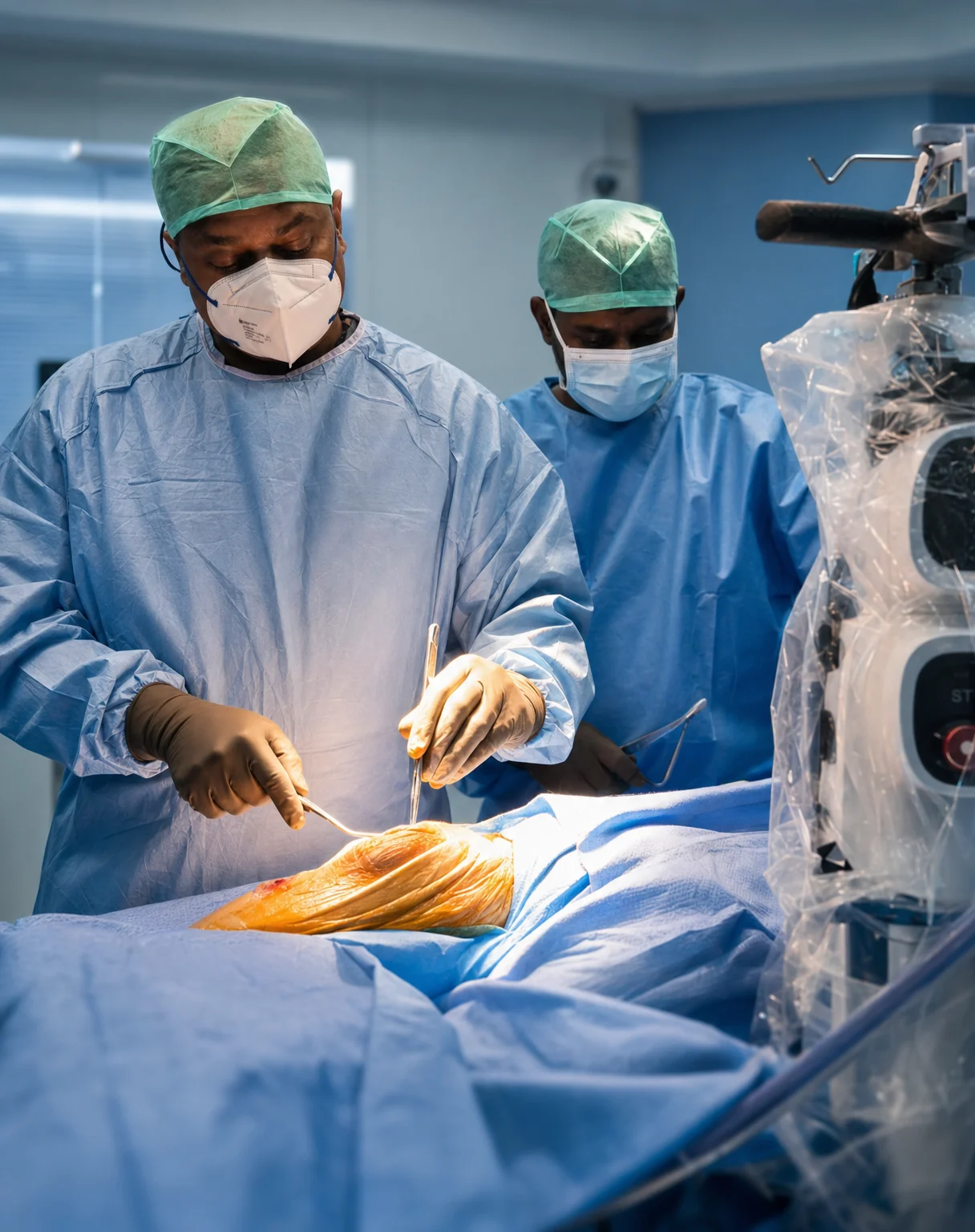
Dr. Prakash Selvam performing robotic-assisted knee replacement
Robotic-assisted
knee alignment
Dr. Selvam at CTS Anna Nagar
Plainly put

What robotic knee replacement actually means.

A standard total knee replacement removes the damaged joint surfaces and replaces them with a metal-and-plastic implant. The result depends almost entirely on alignment - how perpendicular the implant sits to the long axis of the leg, how the rotation is set, how the soft-tissue tension is balanced.

In a manual procedure, the surgeon aligns the implant using jigs and visual judgement. Skilled surgeons do this very well. The best are within 2-3 degrees of the planned alignment on most cases.

In a robotic-assisted procedure, the system maps your specific knee anatomy from a pre-op CT scan, then guides the bone cuts to within one millimetre and one degree of the plan. The robot doesn't move autonomously. It restrains the saw so it can only cut within the planned envelope. The surgeon's hand still drives the surgery - the robot just removes the millimetre of room for error.

The clinical evidence over the last decade is consistent: better alignment leads to longer implant life and lower revision rates. The trade-off is cost, which is ₹30,000-60,000 more per procedure than the manual equivalent.

Is this right for me?

Robotic is the right answer when…

  • + You're a younger or more active patient (60s or below), so the implant has to last 20-25 years
  • + Your knee has complex deformity - significant varus, valgus, or bowing
  • + Previous knee surgery has changed the bony anatomy
  • + You want measurable, document-able implant alignment for the medical record
Manual is the right answer when…

Standard total knee is the right call when…

  • · You're 75 or older with end-stage osteoarthritis and standard anatomy
  • · You're cashless on a budget insurance policy that won't cover the upgrade
  • · Your knee has minimal deformity and clear surgical landmarks
  • · You're a candidate for partial (uni-compartmental) replacement instead

We will not push robotic if your case doesn't benefit from it. We will tell you what your case is.

The pathway

What happens, step by step.

1

Consultation and assessment

OPD visit with Dr. Selvam. Examination, X-ray review, your existing scans if any. Discussion of whether knee replacement is the right intervention, or whether non-surgical management is still appropriate. If surgery is indicated, we explain manual vs robotic options including the cost difference.

2

Pre-operative workup

Blood tests, ECG, anaesthesia fitness review. CT scan of the affected knee for the robotic planning system. Detailed cost estimate within four working hours. If you're cashless, we begin pre-authorisation with your TPA before admission.

3

Admission, day before surgery

Admission to your booked room class (single or twin AC). Final consultations with the anaesthetist and physiotherapist. Light dinner, fasting from midnight. The surgical team confirms the next morning's plan with you and a family member.

4

Surgery day

Procedure typically begins by 8:00. The operation itself takes 90-120 minutes. Spinal anaesthesia is the default, with general anaesthesia available if preferred. Dr. Selvam performs the surgery; the robotic system constrains the bone cuts to the pre-operative plan. You're back on the ward by midday.

5

Day 1 - 3 post-op

Physiotherapy begins on day 1. Most patients are standing and taking guided steps by day 3. Pain management, wound dressing review, baseline mobility check. The orthopaedic resident and Dr. Selvam check in daily.

6

Discharge, day 3-4

Discharge typically on day 3 or 4. Detailed home recovery plan, medication list, contact number for any concerns. First follow-up in clinic at 10-14 days. Second follow-up at 6 weeks. Twelve-week check confirms full recovery.

7

Recovery timeline

Light walking at home within a week. Most patients drive again at 4-6 weeks. Return to office work at 4-6 weeks. Return to recreational sport - low-impact only, like swimming and cycling - at 12 weeks. High-impact sport is not recommended after knee replacement; we will explain why during your consultation.

Money, plainly

What this costs at CTS.

Indicative price bands. Detailed estimate within four working hours of your consultation. If you're paying cashless, pre-authorisation begins before admission.

  • + EMI options through Bajaj Finserv, HDFC, and Arogya Finance
  • + 42 insurance providers empanelled for cashless
  • + No hidden costs - the estimate is the bill
How cashless works

Robotic Knee Replacement

Indicative ranges. 3-night stay, standard CE-certified implant, full surgical team.

Single AC room 3-night stay ₹2.8 - 3.2L
Single AC, premium implant longer-life ceramic-on-poly ₹3.2 - 3.6L
Bilateral (both knees) one admission, one anaesthesia ₹5.4 - 6.4L

What this includes
  • + Surgeon's fee, anaesthesia fee, OR charges
  • + Standard implant (model and brand confirmed at consultation)
  • + Robotic planning, CT scan, intra-op robotic time
  • + Room for three nights (single or twin AC as chosen)
  • + Three post-op physiotherapy sessions
  • + All in-hospital medications and dressings
  • + Two follow-up clinic visits at 14 days and 6 weeks
What it doesn't include
  • - Premium implant upgrades beyond the standard offering
  • - ICU days beyond standard (most cases need none)
  • - Take-home medications
  • - Extended physiotherapy beyond three sessions
  • - Treatment of unexpected complications
tbd Final price ranges to be confirmed with the CTS billing desk before launch. Numbers shown are realistic Chennai market positioning for a 35-bed independent hospital with robotic capability.
Questions we hear most often

FAQ

How long does a knee replacement last?

A well-placed modern knee implant typically lasts 20-25 years in the average patient. Active or younger patients may wear them out faster. The robotic-alignment advantage is most relevant for patients whose implant has to last the longest - so younger patients in their 50s and early 60s benefit most.

Is robotic surgery safer than manual?

Safety is comparable in skilled hands. The robotic advantage is precision of alignment, not safety in the operating theatre. Dr. Selvam has performed over 5,000 hip and knee replacements - the robot adds millimetre accuracy on top of that experience, it doesn't replace it.

Will my insurance cover the robotic upgrade?

Most policies cover the procedure but treat the robotic component as an upgrade with partial or no coverage. We pre-authorise the standard procedure cashless, and the ₹30-60K robotic upgrade is typically out-of-pocket. The TPA desk confirms the specifics for your policy before admission.

What if I need both knees replaced?

Bilateral (both knees in one session) is possible if you're fit enough. Hospital stay is the same as a single, recovery is longer. Some patients prefer staged replacement (one knee at a time, three months apart). We will recommend based on your fitness and lifestyle.

What's the recovery like?

Walking with support on day 3. Most patients walk unaided indoors at 2 weeks. Driving at 4-6 weeks. Full return to non-impact activity at 12 weeks. The biggest factor is consistency with the physiotherapy programme.

Can I get a second opinion before deciding?

Yes. Bring your existing X-rays and any prior surgical advice. We give second opinions for the consultation fee and have no commercial pressure to recommend surgery - we will tell you if non-surgical care is still appropriate for your knee.

Dr. Prakash Selvam
Dr. Prakash Selvam Chairman & Chief Surgeon
Your surgeon

The surgery is done by Dr. Selvam himself.

23 years of orthopaedic practice. 10,000+ surgeries total. Over 5,000 hip and knee replacements specifically. International training in the United States, Italy, Switzerland, Japan, and Australia. Certified on the robotic system at CTS.

The surgeon who consults with you, who quotes the price, who explains the implant - that's the same person you'll see in theatre. No swap-outs.

Full clinical profile
Next step

Bring the X-rays. Bring the questions.

A consultation with Dr. Selvam will tell you whether your knee needs replacing at all - and if so, whether robotic is the right call for your case specifically.